
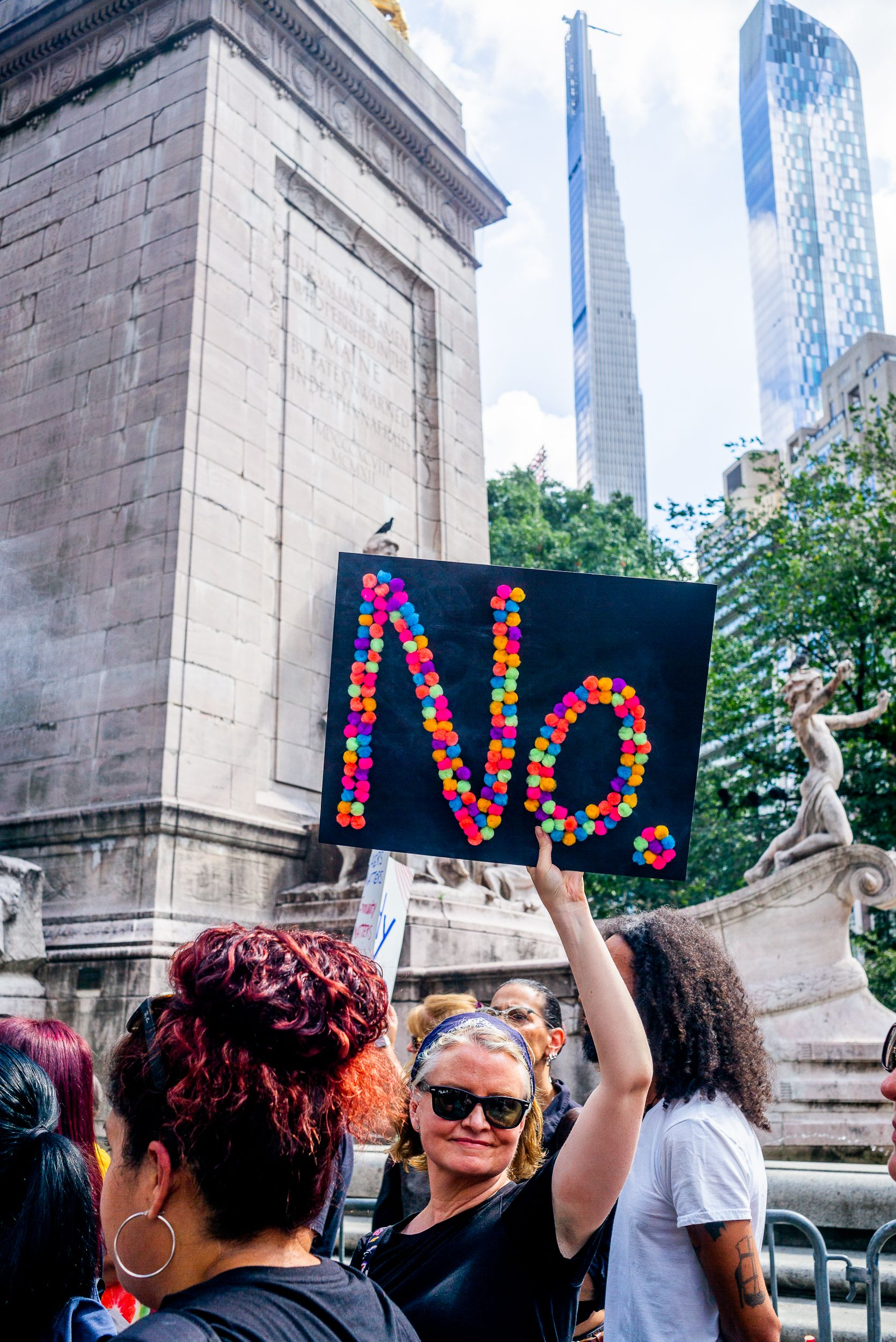
Getting to NO
I learned early that to stay safe, to survive in my environment, I had to silence my voice.
I learned that I had to agree with everything the big people in my environment said and did. They were right. They were bigger, older, faster, stronger, and if I wanted food, if I wanted to be free from pain, if I wanted to be free from angry door slamming and tension and uncertainty and unpredictable encounters with the razor strop that hung menacingly from the bathroom radiator, I just needed to say yes, yes, yes.
Yes, you are right. Yes, this way you require of me is correct. Yes.
I learned to be more than just a yes. I learned to be enthusiastically YES.
YES, whatever you say. YES to this, YES, most vehemently YES to that. If they were YES, I was you-are-absolutely-a-thousand-percent-right YES.
I was the first one to stand in line shouting to the masses how YES I was, how right the YES was that I was advocating, and how absolutely perfect this YES position was. Because the people in my environment who told me this was the way things were—they were right. They were the only ones who were right.
I agreed with them because that was the only way to think about things. It was a no-brainer. It was absolute.
I was YESsier than any other YES anyone could ever have imagined.
Yes yes yes yes yes yes yes yes YES.
Everything I did or said or thought, I did or said or thought to make points with them. To please them. To gain their approval.
So that I could survive.
To the best of my ability, I out-thought them. I pre-thought them.
What would be the safest thing for me to say and do in this situation? In that one? Before the potential abuse happened, I tried to figure out the safest thing to say and do to improve my chances of survival.
Get good grades? Oh, okay—I’ll get the best grades anyone ever got. I’ll show YOU.
Wear a knee-length dress in the days of miniskirts because that’s what got me my YES? Sure! I’ll wear whatever you want. Just approve of me. I’ll even go to school and tell everybody that short skirts are terrible.
No makeup, because we don’t do makeup in this household? Sure. Whatever you say. Makeup is for someone else, not me. Makeup is for girls who get themselves into trouble.
I don’t get in trouble.
I wasn’t even aware it was happening, this giving away of my voice.
I remembered a few times when it was beaten out of me, “for my own good,” accompanied by the assurance that “this will hurt me more than it will hurt you.”
But I didn’t realize that my voice was slowly, surely disappearing.
I traded what I knew to be true within myself for someone else’s voice, so that I could survive.
So that I would be safe.
A boyfriend appeared. I stayed safe with him and kept my voice quietly tucked inside.
I went to college and graduated in record time with the highest grades possible, so that everyone would be proud of me.
My pottery teacher told me I needed to stay another year and get a third major—in art.
How could I? I was already planning my wedding for the upcoming June. I couldn’t back out now.
I married the boyfriend.
He assumed the role of dictating what would and would not be acceptable for me to say and do and think.
And I agreed with him.
I said YES, most absolutely positively YES.
Children came. I worked in a career I absolutely loved, a career where I could just sit and listen and take dictation and have no voice.
My voice did not matter.
On Saturday mornings, I took pottery classes at the local cultural center. In pottery class, we could have voices with each other, because with these women, it didn’t matter.
We could laugh. We could say yes.
We could also say no.
Then came a day when I saw something that made me say NO.
I was working as a court reporter during an assignment. A husband was sitting there verbally abusing his wife, right in front of his attorney and hers.
And the wife sat there and took it. Absorbed it.
I had the strong impression that she’d been absorbing it for decades, and soon now she was going to be done taking it.
I most definitely wasn’t going to allow that abuse to go on right in front of me.
I said NO inside myself and asked for a break, requesting to speak privately with the attorneys.
I learned that day that my voice did not matter.
I was a mere court reporter and mattered to them about as much as a chair or the table mattered.
I understood that if I insisted on speaking my truth—NO, there will be no abuse, not in my presence—I wasn’t going to be employed much longer.
That day, I decided I had to do something different.
This wasn’t working for me.
I remembered that right after college, I’d wanted to get a master’s degree. But for the life of me, I couldn’t figure out what area of study might interest me enough to pursue.
I’d put that dream aside during the years of children, husband, courtrooms, and dictation.
Now the children were leaving for college and coming home on holidays, talking about classes and professors and learning and books.
I kept my ears open and looked for where the path might open.
It was an advertisement on the local public radio station that caught my attention.
I attended an orientation and considered my options.
Not even knowing quite what I was choosing, I began seriously considering a master’s degree in conflict resolution.
But was that logical?
I’d never heard of a master’s in conflict resolution.
What even was it?
What did you do with it? What kind of job could you get? Was it practical? Could I make a living with it?
I made it my mission over the next few months to get some answers.
Someone out there had to know what it looked like to have a master’s degree in conflict resolution.
The next thing I knew, I was in Minnesota, where the Mennonites had invited me to speak about my children’s book at their regional conference.
One of the presenters caught my attention during the opening remarks.
He was Black and referred to himself, with wonderful self-effacing humor, as the “token Black Mennonite.”
He was also the keynote speaker for the first evening’s session.
Over the next two or three days, we probably spent eight hours talking. An hour or two in the library here, an hour or two in the dining hall there.
The gift he gave me changed my entire life.
Of course, I had to ask him about conflict resolution.
Could I get a job in the field? What did he know about it? What could he tell me?
He never answered my question.
Not in eight hours of conversation.
And he gave me back my voice.
Of course, my voice had never actually left me.
I’d buried it somewhere deep inside, under all the YES YES A THOUSAND TIMES YES, under all the people-pleasing, the manipulation, the pre-thinking and out-thinking I’d done my entire life so that I could survive and not be hurt.
He sat with me in those little rooms and asked me questions.
Open-ended questions.
Questions with no right answers.
Questions that made me dig deep inside and give him my answer.
For ME.
I couldn’t give him an answer that would please him because he didn’t particularly care what the answer was.
I couldn’t out-think him because there was nothing to out-think.
I was entirely safe.
In those rooms, there was nothing to fear.
It didn’t matter if we were overheard. I couldn’t give him an answer that would make him happy, or withhold an answer because it might make him angry.
Whatever I said, if it was true for me, if it was my answer, then it was what I needed to say.
I probably cried most of the time we sat together.
No one in my life, ever—and by now I was 41—had simply sat with me and asked me what was true for me.
What did I think about this? About that? What did I collect? What interested me?
And the thing was, he sat still and listened.
He didn’t have to rush off to another appointment or another keynote address.
He had time to spend with me as I melted down in front of him.
We talked in several large chunks of time until I was talked out.
I really don’t remember most of what we talked about.
And that wasn’t important.
He listened.
He made the space for me.
I talked.
I had never really talked before.
No one had ever made it safe for me to discover what was inside me, what “me being me” was all about.
Who was I, really?
I didn’t know.
I’d thought I was all the YESes I’d been saying to everyone my whole life so that I would be safe.
That wasn’t the real me at all.
At one point, I told him that I collected dishes—that I had this weird obsession with collecting sets of dishes.
Neither he nor I could figure out the symbolism of that one!
He told me about a time in his life when he’d been having a hard time and someone had asked him that very same question.
He was a man who had walked in protest alongside Dr. Martin Luther King Jr. He’d been a classmate of Jesse Jackson. He recommended the movie Mississippi Burning to me, saying that it was about as accurate a portrayal as anything I could watch of the times he’d lived through and the people he’d known.
His answer to the question “What do you collect?” had been crucifixes.
He had an enormous collection of pictures of Jesus on the cross. His room was full of statues of Jesus, crucified. He wore crucifixes.
What he identified with most was crucifixion.
The person who had asked him the question said:
“John, take Jesus off the cross.”
In other words, stop seeing yourself as a victim.
We traded stories. He talked about Ebonics; I talked about Native American history. His children were part Native, too.
Eventually, we both had to go.
I drove home, changed.
I enrolled in the master’s program in conflict resolution, still having absolutely no idea what on earth I’d do with the degree, whether I’d regret the decision, whether I’d ever pay off the student loan, or whether anyone would hire me.
It had been a confusing, sensual experience, being truly listened to for the first time in my life.
It took a while for me to understand that this wasn’t about attraction.
This was how it felt to be honored.
This was how it felt to be given air time.
This was how it felt, for the first time, to connect with the Wisdom within.
This was how it felt for that inner Wisdom to be released.
This was how it felt to be listened to respectfully, with no agenda, nobody to please, nothing expected in return.
My life until then had been so transactional.
Say this, do this, and I’ll give you food.
Behave this way, and I’ll give you approval and not a beating.
Be as you were at seventeen, submissive and cute, or I’ll hit you.
Yes, yes, yes. I’ll be good.
Yes, yes, yes. I’ll behave.
Yes, yes, yes. I’ll say what you want me to say.
I’ll even believe that I believe it.
I’ll prove to the whole world how much I believe in you. I’ll out-YES you and everybody else.
Just you watch.
I completed my master’s degree in conflict resolution, wrote my thesis, reclaimed my voice, and followed my dream of doing what I could to help Native women find their voices, too.
I facilitated meetings where Native families facing the possible removal of their children by the child welfare system could come into the room knowing they were respected.
Knowing they would have time to express themselves fully, at their own pace.
Knowing their words would be honored and valued.
Knowing I would listen and take them seriously.
I made space—with plenty of tissue boxes handy—for Native women to discover the truth within themselves and speak it aloud in safety.
And in doing so, I continued learning the art of honoring my own voice, getting to know who I truly am, and saying, clearly and confidently when I have to, and with the greatest love possible,
NO.
